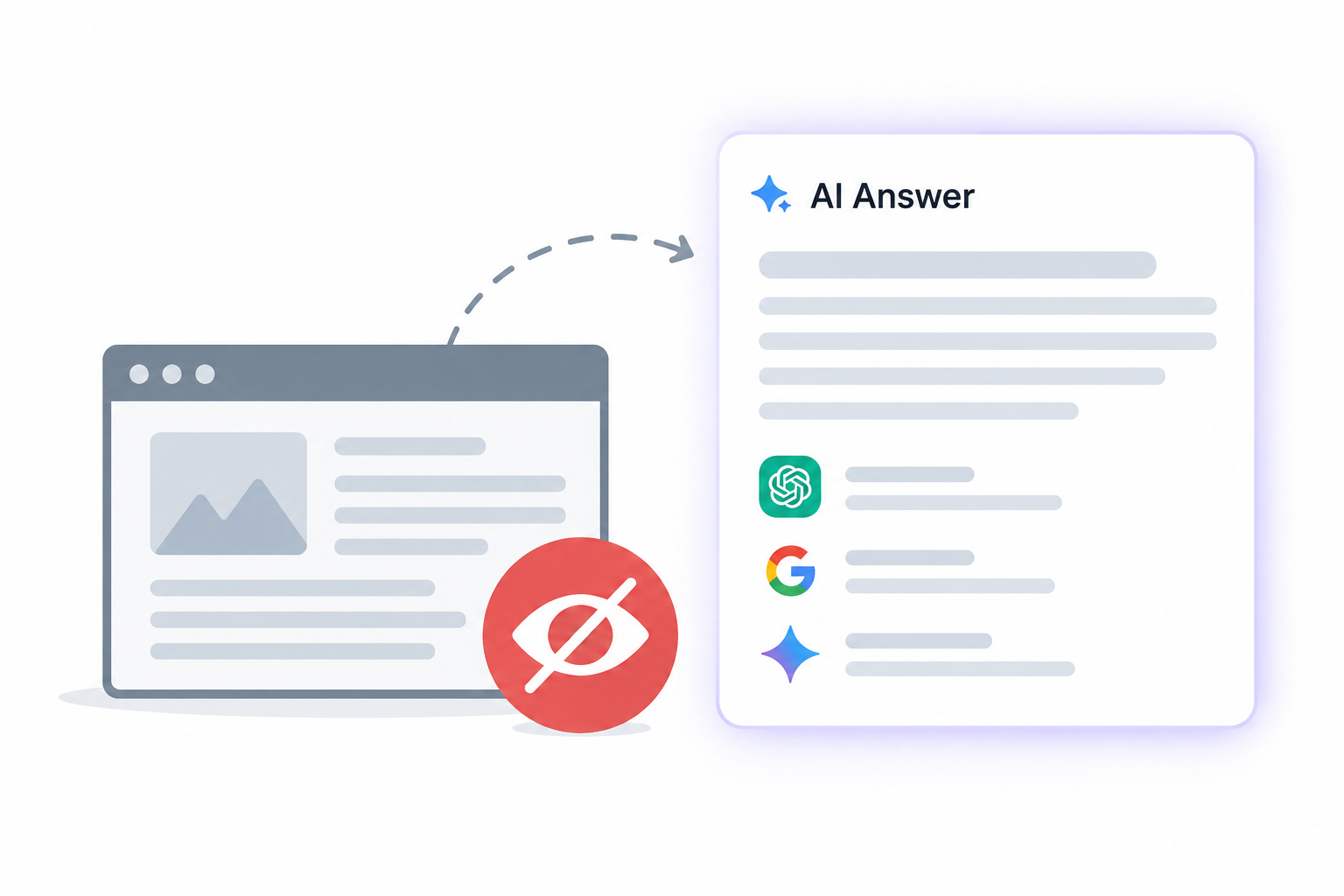
You’ve probably seen it happen. You search for a product or service your company offers, ask an AI tool for recommendations, and find several competitors mentioned in the response. Your own business doesn’t appear, even though you’ve invested time and money in your website.
It’s tempting to assume your SEO strategy isn’t working. But the situation is a little more complicated than that.
Google rankings, organic traffic, and visibility in AI-generated answers measure different things. A website can perform well in traditional search and still be absent when ChatGPT, Perplexity, or Google AI Overviews answers a question.
The first step is figuring out why. In some cases, the problem is technical. In others, the website simply doesn’t provide enough useful information, or competing businesses have established a stronger presence across the web.
Here is why your site might be missing from AI search answers—and what you can do to fix it.
1. Your Content Doesn’t Answer Questions Directly
AI tools exist for one reason: to give people fast, accurate answers. If your pages are crammed with generic corporate jargon or three paragraphs of filler intro, an AI scraper will pass right over you.
Consider this line: “We deliver innovative, industry-leading digital transformation solutions.”
That means nothing. It gives zero information to a human reader, and it gives zero context to an AI crawler. Contrast that with a page that states the exact problem you solve, your step-by-step process, and real benchmark numbers.
Fixing your content for AI:
- Start with the answer right away under your heading, because AI search engines break content into small chunks and are more likely to pick up clear, direct answers than information buried halfway down the page.
- Skip the fluff and answer real client questions head-on.
- Write headings that sound like natural questions real humans ask out loud.
- Back up every big claim with documented outcomes and real case studies.
- Use hard numbers, clear teardowns, and side-by-side comparisons.
- Ignore the promotional claims. Replace them with verifiable facts.
When your content packs dense information into concise sentences, AI engines actually have something worth citing.
2. Fixing Your Brand Entity Footprint
If an AI model can’t connect your brand name to a verified real-world business, it won’t take the risk of quoting you. Setting up machine-readable proof is your first step:
- Claim your Entity Home. Slap explicit JSON-LD Schema on your homepage—specifically
Organization data with SameAs links pointing straight to your Crunchbase, LinkedIn, social profiles, and state registry files. It takes 20 minutes and cuts out the guesswork for crawlers.
- Stop relying purely on your own site. Get featured on external review platforms, guest on podcasts, and contribute to industry roundups. AI models need independent confirmation that you exist.
- Publish data worth stealing. Pitch original Digital PR campaigns. When you run an industry survey or publish internal benchmark data, journalists and other blogs link back to you naturally. That off-site paper trail is gold for LLMs.
3. Technical Problems Could Be Preventing Your Content From Being Found
Great content won’t help you if a crawler gets locked out at the door.
AI search platforms rely on a fast-moving chain of web crawlers, indexers, vector databases, and language models. If any link in that chain snaps, your content disappears from the final answer.
The most common self-inflicted wound we see? Blocking AI crawlers in robots.txt. A lot of site owners tweaked their robots.txt files to block web scrapers out of data privacy concerns, accidentally locking out live search bots like OAI-SearchBot or PerplexityBot at the exact same time.
Your quick technical audit:
- Check your crawler rules: Inspect your
robots.txt file today. Make sure you aren’t accidentally blocking search-oriented AI bots.
- Keep response paths clean: Verify your main pages return crisp
200 OK status codes without weird redirect loops.
- Maintain active XML sitemaps: Keep sitemaps updated and submitted across search engine consoles.
- Use clean HTML structure: Break content up with clear
H2 and H3 tags and logical internal links.
- Remove rendering barriers: Don’t hide core answers behind heavy JavaScript, gated popups, or login walls.
If traditional search engines struggle to index your content, AI engines won’t stand a chance.
4. Building Topic Authority Without Spamming Content
Publishing a dozen random blog posts won’t convince an algorithm that you own a niche. You need clear structural depth:
- Build dedicated topic hubs. Create one definitive resource for a core service, then branch off into detailed sub-pages that tackle specific questions.
- Link contextually. Connect those sub-pages back to your main pillar page using real descriptive anchor text—not generic “click here” links.
- Bring real numbers to the table. Cut out long-winded intros. Drop in raw campaign data, precise test parameters, and failure points.
5. Your Off-Page Strategy Belongs in 2018
High-volume, low-grade directory links won’t help you win AI answers. Modern retrieval engines care far more about editorial context and unlinked brand mentions in high-trust spaces.
- Get quoted in actual media outlets. Pitch commentary to trade publications where your clients actually spend time reading.
- Be active where real humans talk. AI scrapers heavily index Reddit, niche forums, and comment threads to gauge real-world consensus. If your brand is completely absent from community conversations, you’re missing a major signal source.
A quick distinction: Brand mentions tell an LLM who you are (entity awareness). Backlinks give readers a direct click-through path. You need both—so stop burning budget on vanity link metrics that carry zero editorial weight.
6. Stop Treating Every AI Engine Like It’s Google
Lumping every platform into the same basket is a quick way to waste your optimization budget. Each engine has a completely different retrieval architecture:
- Google AI Overviews: Relies heavily on Google’s existing web index, standard organic rankings, and traditional quality signals. If you don’t rank in top traditional results, you rarely get pulled into the overview.
- Perplexity: Pulls aggressively from live search APIs, Reddit threads, news feeds, and clean, scannable bullet points. It rewards freshness and direct facts over domain age.
- ChatGPT Search: Combines custom retrieval crawlers with direct media licensing deals and real-time indexing.
If you want visibility across the board, you can’t just optimize for traditional Google indexes—you have to format content so real-time retrieval bots can grab facts in milliseconds.
7. You Have Zero System for Tracking AI Visibility
You can’t fix what you don’t track. Traditional SEO reports focus on keyword positions, organic traffic, and conversion rates. Those metrics are still vital, but they won’t tell you if ChatGPT is sending prospective clients to your biggest competitor.
Start running structured prompt tests across the AI platforms your buyers use.
For example, query prompts like:
- Which agencies specialize in AI search optimization?
- How can a B2B company improve visibility in ChatGPT?
- What should I look for when hiring a link-building team?
Track four simple things:
- Does your brand appear in the written answer?
- Did the platform include a direct citation link to your website?
- Which competitors were mentioned instead?
- What third-party sites were referenced as sources?
Test these prompts regularly. AI answers shift based on location, prompt structure, model updates, and live web availability. Tracking these patterns reveals your exact content gaps.
How to Improve Your AI Search Visibility
Getting picked up in AI answers requires blending solid technical SEO with broad brand discoverability:
- Audit Crawlers & Code: Ensure search-focused AI bots aren’t blocked in your
robots.txt, fix indexation bottlenecks, and clean up schema markup.
- Write for Quick Extraction: Structure pages to answer questions immediately (BLUF approach) and swap generic marketing copy for high-density facts.
- Establish Machine-Readable Authority: Organize content into distinct topic clusters, deploy explicit schema, and support claims with clear evidence.
- Scale Digital PR: Focus on earning media coverage, industry quotes, and brand mentions on authoritative external sites.
- Track Multi-Engine Visibility: Periodically test target prompts across ChatGPT, Perplexity, and Google AI Overviews, adjusting your roadmap based on real data.
There’s no secret button for guaranteed AI inclusion. Citations change as models update and web data evolves.
Final Thoughts
If your site isn’t showing up in AI answers, the solution is rarely as simple as tweaking a meta description or launching a few new blog posts. The real issue usually sits at the intersection of technical accessibility, information density, machine legibility, and external brand authority.
The companies that win in this next era of search will be the ones that combine clean, machine-readable websites with dense, expert-led content and a legitimate off-site reputation.
At PragoMedia, we build digital authority that both human buyers and AI search systems recognize. By combining technical SEO, strategic link building, entity optimization, digital PR, and AI search strategy, we help brands establish lasting visibility across traditional search results and emerging AI discovery channels.